Where Possibility Survives
Layla Foord
Most organisations say they want innovation. Structurally, emotionally, behaviourally, many reward predictability instead. And you can see it most clearly in the rooms where decisions quietly refuse to move.
Sean Flaherty was speaking at Leading The Product in Melbourne. His talk was on leadership and the art of possibility. If you get the chance to see him, go.
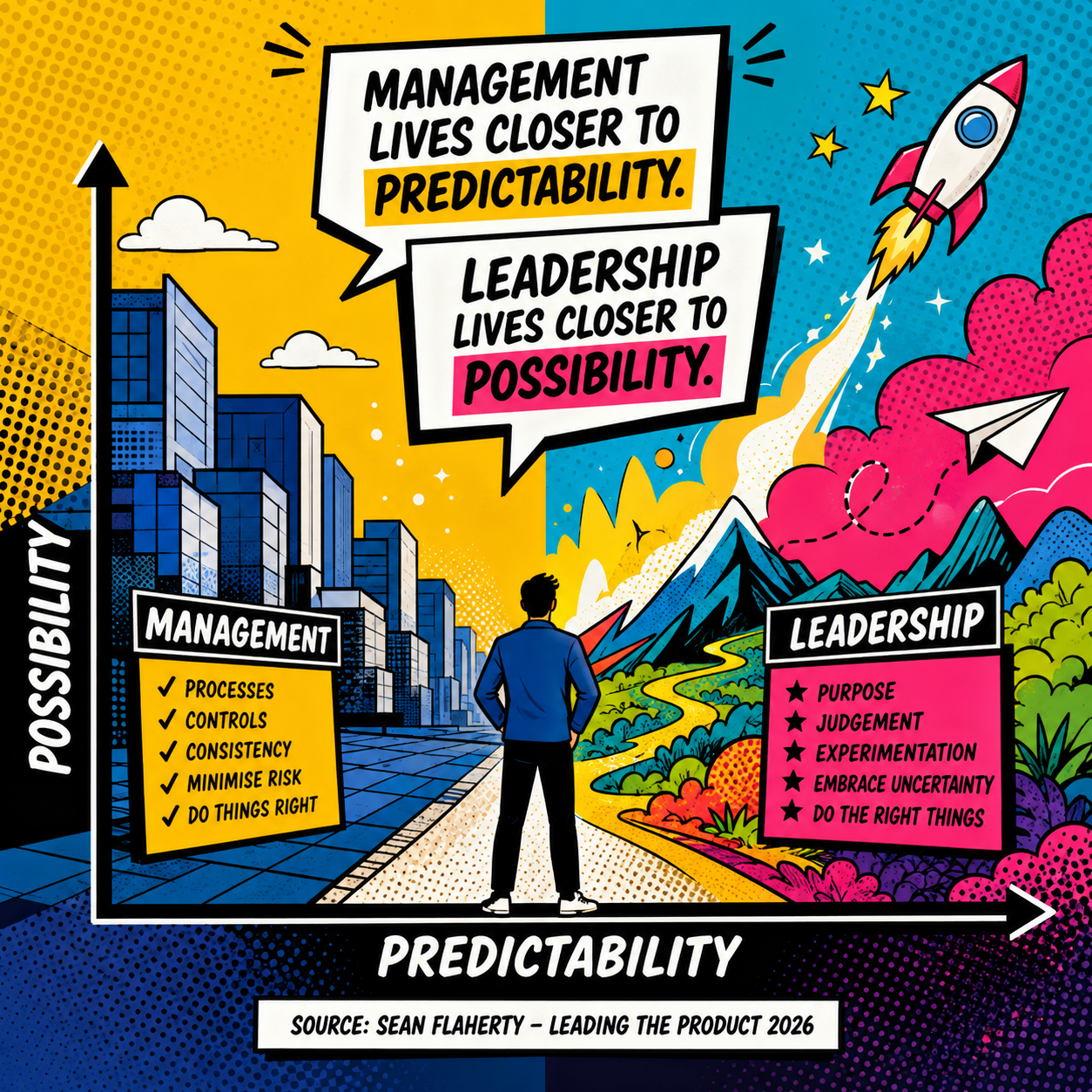
Sean showed a simple chart.
On one axis: predictability. On the other: possibility. Management, he suggested, tends to live closer to predictability. Leadership closer to possibility.
It was one of those observations that stayed with me, because it named something I'd been trying to articulate for a while.
Most organisations say they want innovation. They want people to exercise judgement, take initiative, try things. In many cases, they genuinely mean it.
But structurally, emotionally, and behaviourally, many reward predictability instead. Not because they're dishonest. Because people inside systems adapt to what they learn is actually safe.
The learning is rarely explicit. Nobody announces that mistakes are dangerous, or that judgement is suspect. The message comes through other channels. The leader's reaction when something doesn't land. The tone in the room after a project fails. What happens to the person who pushed something forward and got it wrong.
Once those signals accumulate, behaviour adjusts. Creativity and judgement quietly reduce. The organisation is still saying it wants possibility. The people inside it have already learned to optimise for something else.
Organisations learn emotionally before they learn strategically.
"I have high standards" is one of the places this plays out most visibly.
It's a phrase that usually means something genuine. Care, ambition, pride in quality, belief in what people are capable of. Leaders who say it often mean it well.
But what people sometimes hear is different. They hear that mistakes are unsafe. That approval is conditional. That the bar exists somewhere, but they're not sure where, which means they can never be certain they've cleared it.
The irony is that the leaders most invested in quality are sometimes the ones who make it hardest for their teams to produce it. Not because they don't care. Because the way they communicate their caring lands differently than they imagine.
The possibility-predictability tension isn't a problem to solve. It's a condition to navigate.
Too much predictability and you get compliance, learned helplessness, intellectual stillness and people going through the motions without much behind the motion. Too much possibility without structure and you get drift and fragmentation, things started and never followed through.
Most organisations don't fail at one end of this. They drift toward predictability slowly, through accumulated small signals, until the people inside have stopped believing that genuine experimentation is survivable.
One sharp reaction from a leader can undo months of "we value innovation" messaging. Not because leaders are careless. Because people are paying close attention to what actually happens, not what's officially said.
What leadership requires here is less dramatic than it's usually framed.
People don't need uncertainty to be gone. They need to believe it's safe enough to move through it. That if something doesn't work, they won't be made to feel like an error. That their judgement is trusted, not just their compliance.
That requires clarity about which standards are genuinely load-bearing and where experimentation matters more than consistency. It requires leaders who react well to failure, not just to success, and trust being extended before it's demanded.
Most people already want to do good work. The challenge is rarely convincing people to care.
It's giving them the right environment to try.
The Pattern
New essays when there's something worth saying
Not on a schedule. Subscribe and get the next one when it's ready.