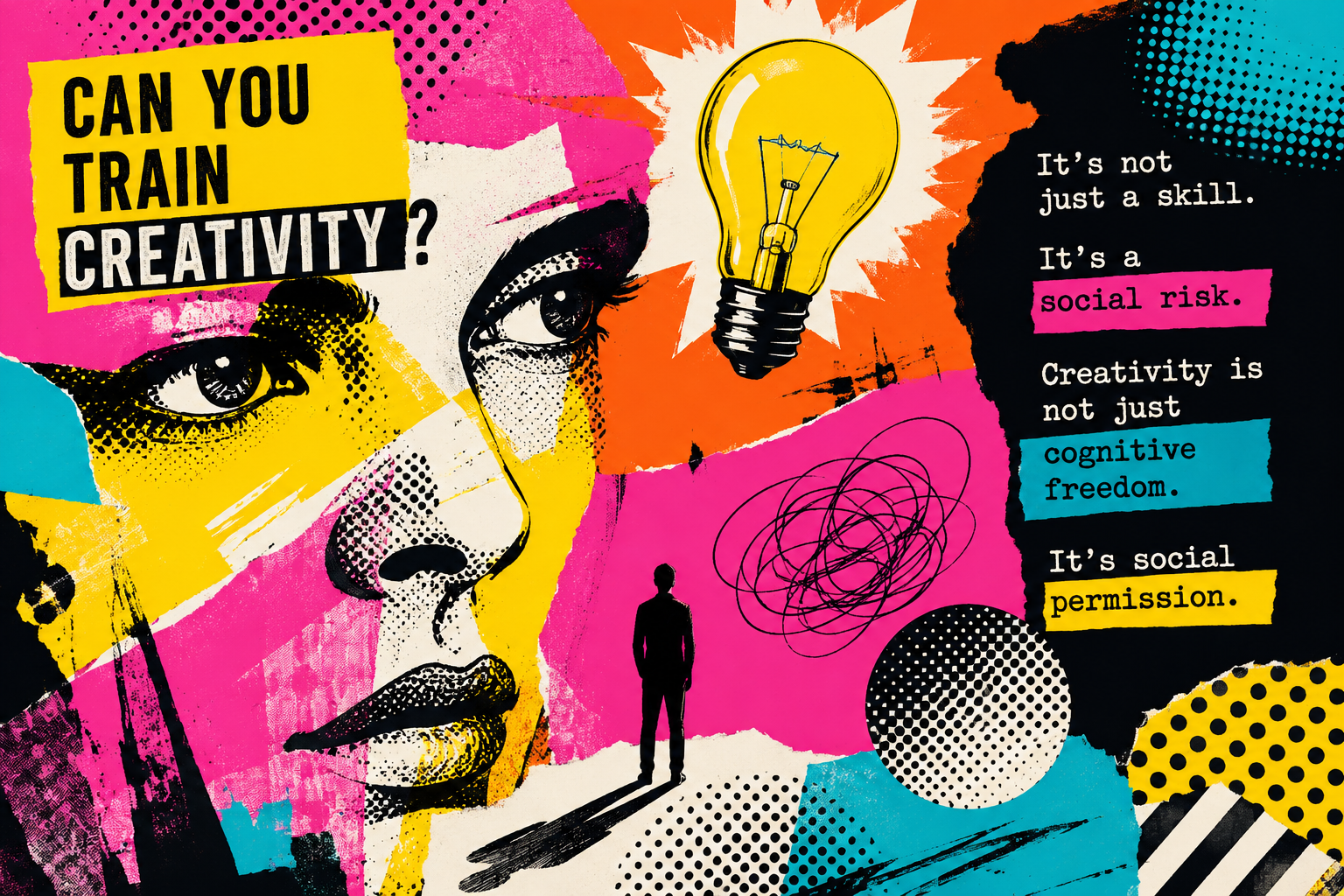
Can you train creativity?
Layla Foord
A friend asked me recently if creativity can be trained. The technical answer is yes. But the harder question is whether the people around a creative person are comfortable enough to let them keep doing it.
A friend asked me recently: can you train creativity?
His name is Gregan McMahon. I've known him since early in my career, when he was one of the first people who seemed to genuinely understand what I was doing, not just what my title said. He now runs a business called Silverback Digital, which does something deceptively simple: takes smart home technology that's been sitting in living rooms for years and builds it into the homes of people living with disabilities, so they can control their environment with just their voice.
That's the context. Hold it there for a moment.
When he asked if creativity can be trained, I said maybe. I've thought about it a lot since.
The technical answer is yes. There are frameworks, workshops, whole methodologies built around divergent thinking. You can learn to generate more ideas, hold problems differently, iterate faster. That part is learnable.
But I don't think that's what actually stops most people.
What stops people is the cost. The specific social cost of making something that might be wrong, or that people might not like, or that's different enough to make the room uncomfortable. The cost of being the person who said the weird thing. Of being told, in some form or another, that what you brought was too much, too soon, not quite what was needed.
That's not a skill gap. That's a risk calculation.
There's a pattern that plays out in organisations, often quietly, and it usually involves someone genuinely creative.
A leader brings them in because they want what that person carries. The way they see things. The willingness to name what isn't working. The ideas that don't come from the existing playbook. They want the creative's energy in the room.
What they don't always anticipate is what it feels like to receive it.
Generating options, when someone isn't yet ready to see them, can feel like exposure. Not because the creative intends that. They don't. They're not thinking about your constraints or your confidence. They're simply making things visible that weren't visible before.
But if you're not quite comfortable enough to receive that, it can read as judgment. As if being shown what's possible is also being shown what you missed. And when it reads that way, the natural response is to close it off. Not the ideas, exactly. The person producing them.
The creative usually doesn't see this coming. They weren't judging anyone. They were just doing the thing they were brought in to do.
That misread is what costs everyone something.
The scope gets smaller. The energy that was an asset becomes something to manage. The system that said it wanted creativity turns out to have meant something slightly different by the word.
Back to Gregan.
He would probably not describe himself as creative. I'm guessing that, and I'd say it to his face if he pushed back. What he's built is creative in exactly the way that matters: he saw a gap the market wasn't filling, took technology that already existed, and rebuilt the problem entirely around human need. Voice-activated environments for people who need them. Not a pitch, not a growth play. A real thing that changes how someone moves through their day.
That's creative. Whether or not the word feels right to him.
And I don't think it's a coincidence that he built it somewhere nobody had opinions about whether it was the right direction, or the right market, or the right time.
So can you train creativity?
Probably. The practices, yes.
But the harder question is whether the people around a creative person are comfortable enough to let them keep doing it. Whether the room can hold what gets generated without reading it as a threat to what they already know.
Sometimes it can. Sometimes it can't.
And most of the time, the creative is the last one to understand which situation they're in.
The Pattern
New essays when there's something worth saying
Not on a schedule. Subscribe and get the next one when it's ready.