AI: From strategic thinking partner to adaptive systems builder
Layla Foord
I've been using AI long enough to see the pattern. I didn't start with agents or retrieval systems. I started where most executives start — with too much complexity and not enough time. The difference is I kept pushing it into harder work.
I've been using AI long enough to see the shape of it.
I didn't start with agents or retrieval systems or Replit builds. I started where most executives start: with too much complexity and not enough time to think it through properly.
The difference is I kept pushing it into harder work.
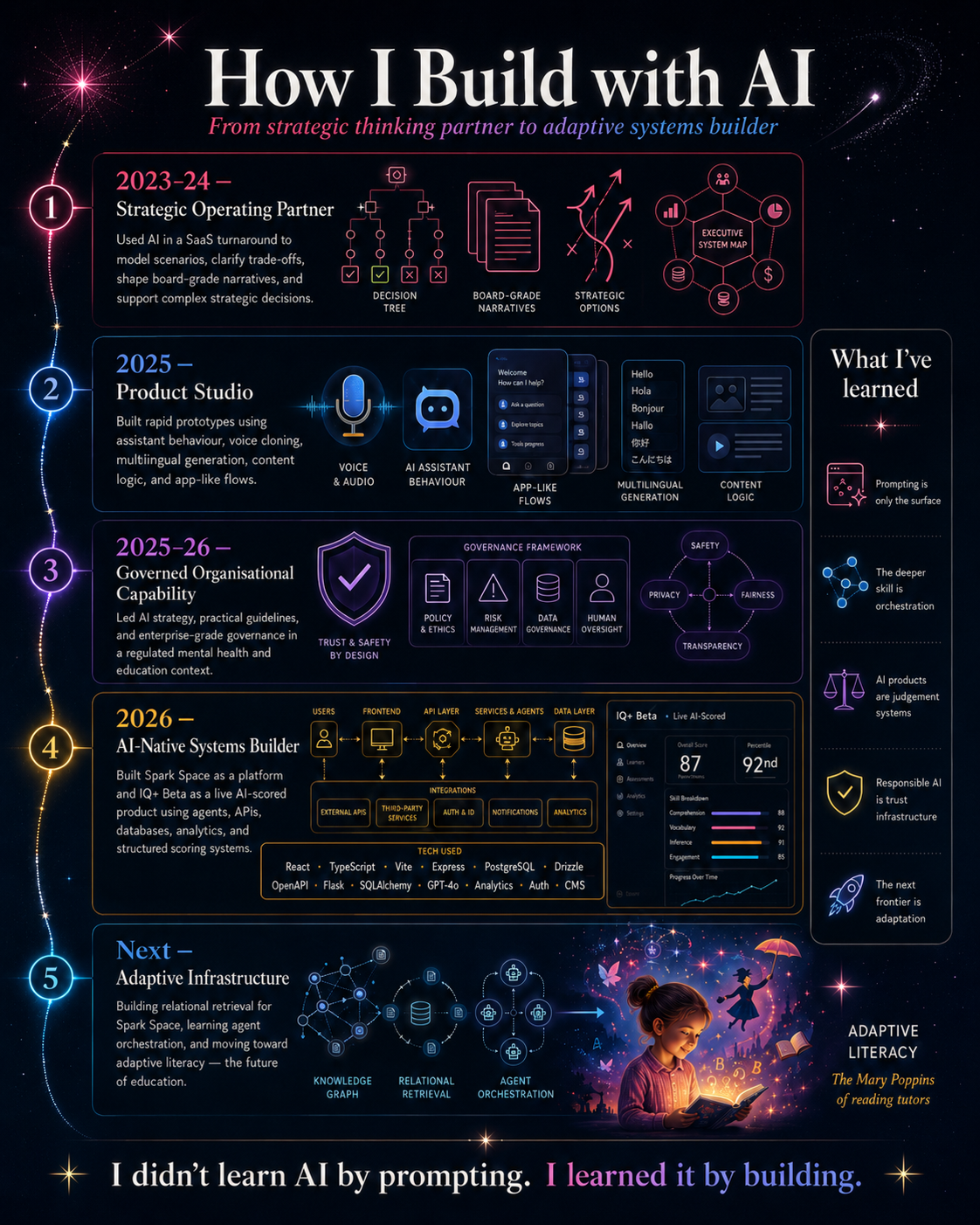
2023-24: Strategy before the trend
My first serious use was in the middle of a commercial turnaround. The business had significant investment in the wrong direction, hard customer feedback, competing strategic paths, and investor expectations sitting on top of an organisation that wasn't sure which way to go.
The question I was working with wasn't narrow. It was something like: do we keep building, restructure, acquire capability, or fundamentally change direction? And what are the second-order consequences of each?
I used AI to make the thinking more explicit. Not to get the answer. To shape the problem into something I could work with.
The value wasn't the first output. The value was the thinking loop.
At the time most people I knew were using AI for emails and summaries. I was using it as a strategic modelling partner: scenario mapping, restructuring logic, board-grade narratives, trade-off analysis. The judgement was still mine. The decisions were still mine. But AI compressed the distance between complexity and something I could act on.
Early 2025: Moving from strategy into prototypes
The next shift came in early 2025. I was working in a regulated wellbeing and education context and started asking a different question: could AI help create more personalised, emotionally attuned experiences for the people this organisation served?
What started as a question became a full product experiment. A child-friendly assistant. Mood-to-content recommendation logic. Voice-cloned audio. Multilingual generation. A working-enough interface to show the idea as an experience, not a slide.
I built the audio outputs in my own cloned voice across ten languages. Not as a concept in a deck. As something people in the room could actually hear.
The point wasn't the polish.
It was the compression. Work that would normally require product, content, UX, translation, audio production and technical coordination could be explored in days. That changed the conversation internally. People could see and hear what might be possible. Not as a trend. As something real.
Mid-2025: The work widened
After that experiment something shifted in how I was working.
I stopped treating AI as a tool for individual tasks and started using it as a creative and cognitive environment. That period is where Spark Space started becoming a platform rather than a blog. Where I experimented with AI-assisted music and ended up releasing an EP. Where ideas about adaptive literacy, emotional technology and cognitive systems started accumulating into something with a shape.
It wasn't a single project. It was a period where I was genuinely exploring what AI made possible across different kinds of creative and intellectual work, and paying attention to what I was learning.
2025-26: Governance as operating infrastructure
The more seriously I used AI in sensitive contexts, the more obvious the governance problem became.
Useful is not enough when you're working with children, mental health, personal data, or any system that interacts with people who are already in a difficult place.
I led the development of an enterprise-grade AI framework for a regulated mental health and education environment. The questions it answered weren't theoretical: what can teams actually use, what needs review, what data should never go in, when does human oversight stay, and what happens when something goes wrong?
Most governance work ends up as a policy document sitting on an intranet. This was different. It was operating infrastructure. Built to let people move faster because they knew where the edges were.
Responsible AI isn't the opposite of innovation. It's what lets innovation survive contact with real organisations.
2026: Building with agents
The biggest shift came when I started building real systems with AI agents. Not mockups. Not code snippets. Actual products with databases, APIs, scoring systems, authentication flows, analytics and deployment.
I rebuilt Spark Space from a blog into a platform. I built IQ+ Beta, a live AI-scored cognitive assessment designed to explore thinking style rather than penalise people for taking longer to think.
That distinction mattered more than I expected.
No time pressure in IQ+ was an intentional product decision. It shaped the scoring system, the UX, the framing, the data model and the ethics of the product. One decision, running all the way through.
That's what I mean when I say AI products are judgement systems. Not just software with a model attached.
I'm not a traditional engineer. I don't write every line. But I understand enough now to direct builds, evaluate trade-offs, identify where something is structurally fragile, and keep the technical implementation connected to the product intent.
The skill I've developed is orchestration.
What's next
The thing I keep running into is context.
AI can produce useful outputs. But it's only as good as what it can access, retrieve and apply. The limitation isn't generation. It's memory.
So the next thing I want to build is a retrieval layer for Spark Space. Something that can surface the right prior thinking, tone guidance, project decisions and writing examples for a given task. Not a blank system. A collaborator with a memory.
After that, I want to apply the same architecture to adaptive literacy. A reading companion that adjusts to a child's pace, confidence, cognition and interests, rather than forcing every child through the same path. It's an idea that I had a few years ago, but is now possible to prototype and test with real people.
The Pattern
New essays when there's something worth saying
Not on a schedule. Subscribe and get the next one when it's ready.